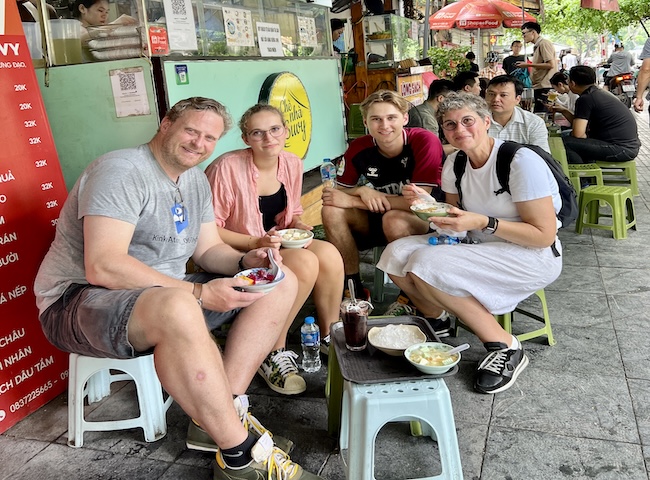
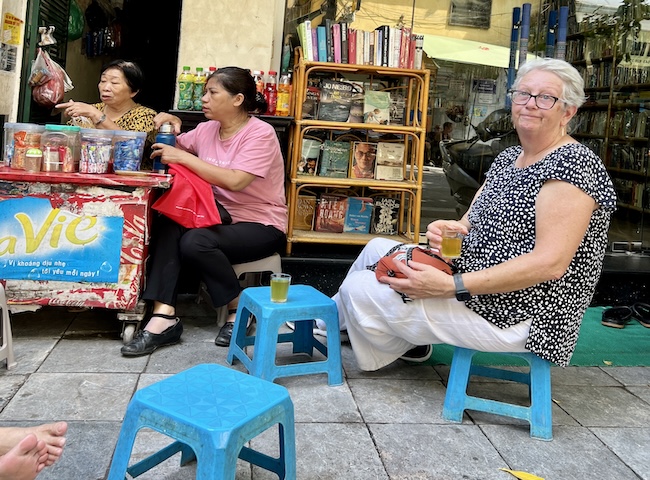
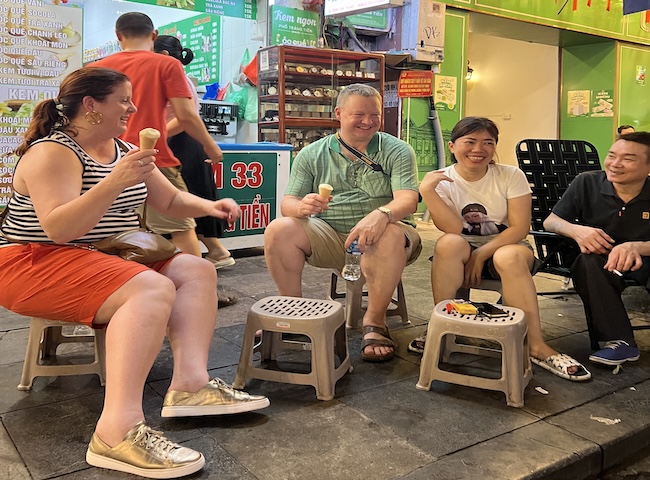
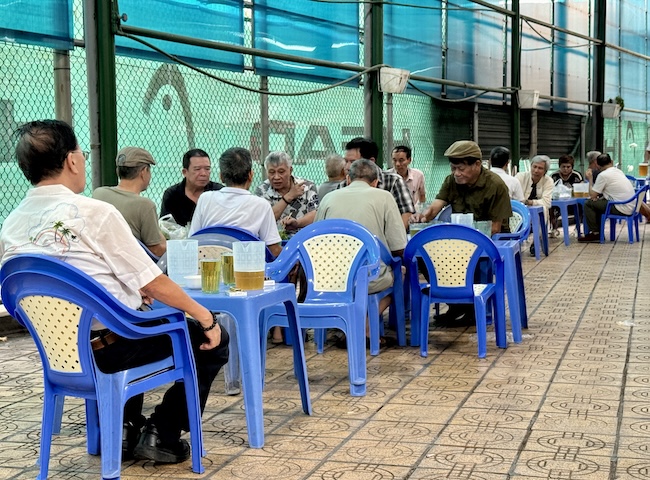
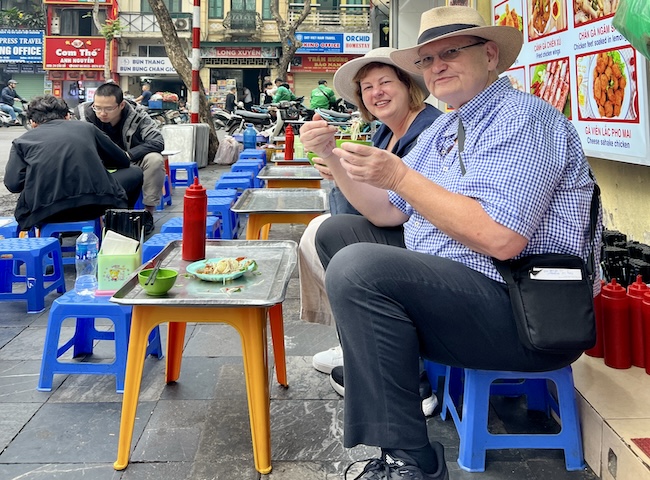
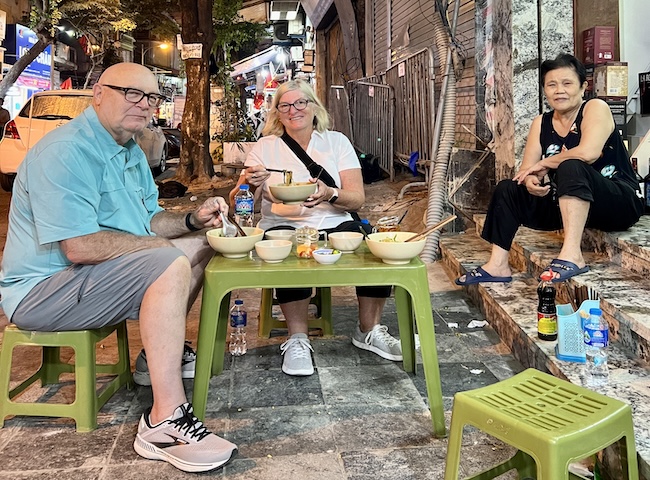
Low stools are everywhere in Vietnam, they’re found on sidewalks, in deserted alleyways, spread around tables, and stacked in the corner of someone’s home. The prevalence of low chairs is so visible in Hanoi that our guests often ask: “Why do Vietnamese sit so low?”.
It’s because of the mix of a deeply rooted habit of sitting on our legs, and the practicality of low stools in our mobile, hardworking life. We generally feel more comfortable sitting on low stools than on higher chairs, while it’s convenient and flexible for vendors to set up their businesses using the low stools.
Habit of Squat Sitting
Vietnamese culture features a long-standing habit of squat sitting (the Asian squat), a common posture used for resting, working, eating, and socializing in daily agricultural activities. It allows people to naturally rest without chairs.
The tradition of squat sitting, and flat-sitting on the ground (ngồi bệt in Vietnamese), is deeply ingrained and predates the sitting on low wooden planks, small stools, and bamboo platforms. Those stools appeared to be high enough to help people comfortably stay off the ground, while still match the preference of sitting low.
Wooden Stools
During the French colonial period, cities were urbanized; dirt roads were concreted with paved sidewalks. The Vietnamese adapted and started using sidewalks for their everyday life, low wooden planks and stools were then seen setup by street vendors.
As a part of street life, food vendors know they may need to clear a sidewalk in minutes when there is urban order management. This fostered a psychology of favoring small, and easily movable set-up rather than the heavy wooden stools.
Plastic Stools Enter Daily Life
From 1986, Vietnam allowed private economy in the Socialist oriented market economy model, it triggered a boom in domestic manufacturing. Plastic production scaled rapidly in the 1990s, factories began mass-producing household goods – including the now iconic plastic tool.
The plastic stools feature lightweight, waterproof, stackable, moveable and cheap characteristics. It allows street vendors to optimize limited space on crowded sidewalks; became an ideal tool for a mobile street life. That explains why Vietnam’s street culture is built around low tables and plastic stools.
The low sitting on plastic stools is now seen everywhere, being a defining image of Vietnam; from the big cities to small villages, highlands to coastal towns, where tiny and portable seats turn sidewalks into cafés or food stalls.