On our walking food tours in Hanoi French Quarter, we walk by the former prison built by the French. Many of our guests visited the site in their Hanoi city tour, many don’t. So our brief introduction about the prison often gives them good information about the city, and in this blog post, we’re sharing the commentary to you.
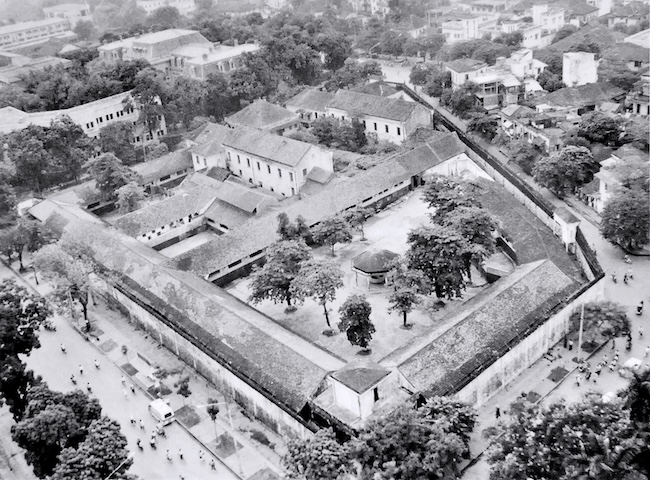

In Vietnamese, the prison is called Hoa Lo Prison – meaning kiln on fire, as it was built on a former ceramic village by the French Colonial Empire. The French built the prison in 1896 to keep the Vietnamese revolutionaries fighting for Vietnam’s independence, and they called it Maison Centrale, or MC. The total size of the prison was about 13.000 square meters, which is almost twice the size of a soccer field.
Initially, the prison was designed to keep only 500 hundred prisoners at a time, but when the French was defeated in 1954, there were more than 2000 Vietnamese being held here, including women and children.
During the 9 years – from 1964 to 1973, the prison was used by North Vietnam to keep the American POWs, who nicknamed it the Hanoi Hilton.
How they got the name Hanoi Hilton?
According to Bob Shumaker, who coined the term “Hanoi Hilton”, in 1965 when he was kept in the solitary confinement, he noticed that there was another American taking a sanitation bucket to the latrine after him. Bob wanted to cheer him up, so he left him a note in the latrine that says: “Welcome to the Hanoi Hilton”.
In early 1990s, about 80% of the prison was torn down for a modern building, then the 20% left became a museum showing the use of the site by both the French and North Vietnam. It’s controversial that the exhibitions were selected to be applicable to our propagandas, as they highlighted the colonial brutality and the “kind treatment” we offered to the Americans while downplaying their reported abuse.

Hanoi Poisoning Plot
In 1908, there was a group of Vietnamese kitchen helpers, trying to poison about 200 French by putting datura powder into their food. It was known as Hanoi Poisoning Plot. Unfortunately, the datura powder wasn’t strong enough to kill any French, so all the plotters were arrested and sentenced to death.
This photo of the being-shackled plotters was taken here before they were executed by a guillotine. Their heads were later hung in bamboo baskets, and displayed in public. Notice that each of them was wearing a device called cangue, a wooden ladder-like collar, which was used for public humiliation.
The Dungeon
The next cell is the solitary confinement, known as the dungeon, and it was used by the French to punish prisoners who broke their regulations. When kept in the dungeon, the prisoners got to eat and poop on the same spot, they couldn’t even rest when lying down, as the floor was made to be lower down from their shackled feet.
As a result, they all suffered from face edema, body swelling, eye diseases, and scabies due to the lack of hygiene and sunlight.
Cells for Female Prisoners
We’re in a cell used for female prisoners, and this is Nguyen Thi Quang Thai, a revolutionary and the wife of the famous General Vo Nguyen Giap. In 1940, when their first daughter was 1 years old, her husband was sent to China to meet Ho Chi Minh for the first time.
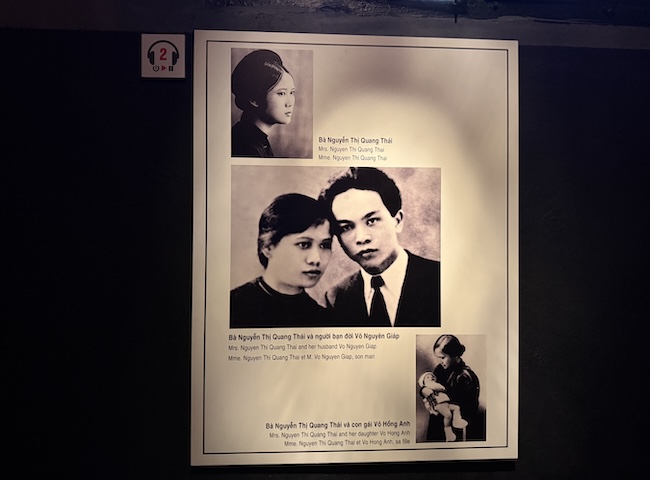
Two years later, while uprising against the French, she was arrested and sentenced to 16 years in this prison. In 1944, when she was kept this cell, she was affected by a bad typhoid fever and died at 29 years old. She didn’t meet her daughter before passing away, her husband didn’t know about her death until 1 year later.
About her husband, General Giap; he used to be history teacher, then followed Ho Chi Minh and became the founder of the Vietnamese People’s Army. He was the brilliant commander in chief of all military operations in Vietnam from 1944 to 1980, and most well-known for defeating the French at the battle of Dien Bien Phu.
The Guillotine
This is one of the two guillotines brought here by the French. It was invented by a French surgeon,Antoine Louis, and then proposed by Joseph Guillotin to be a device to carry out death penalties in Francein 1789.
When executing, the victim’s hands were tired behind his back while lying face down on a wooden table, and his neck was placed between two wooden boards. When the executioner let go the rope, the blade fell down cutting the head. The head dropped into the iron container, the body was then put into the rattan container.
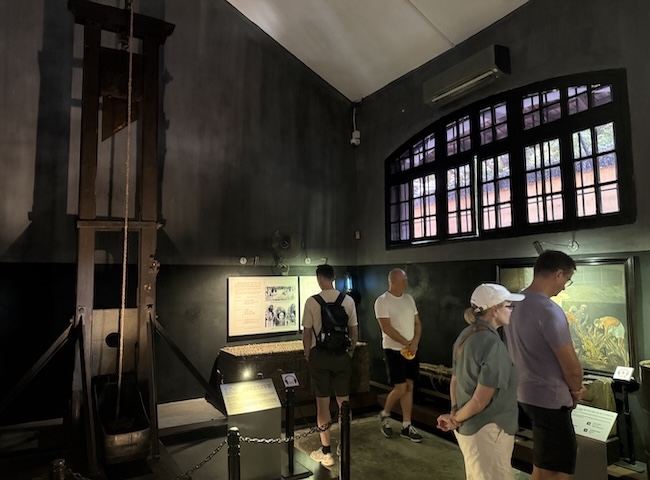
Alongside with the guillotine are some photos of the Hanoi Poisioning Plotter’s heads, contained in bamboo baskets and displayed in public by the French.
Vietnam and France normalized diplomatic relations in 1973, and the relationship was upgraded to a Comprehensive Strategic Partnership. From a complex colonial past, France is now a key European partner of Vietnam with strong ties in trade, defense, education, infrastructure, healthcare, green energy, and aerospace.
The Hanoi Hilton
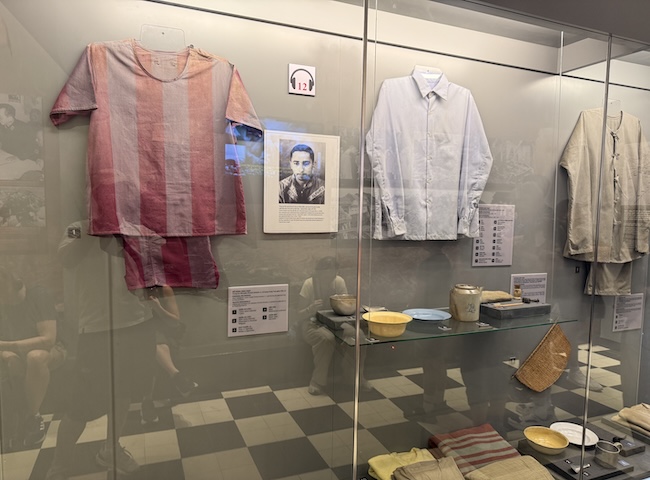
After the Gulf of Tonkin Incident in 1964, this prison was used as one of the locations to keep the American POWs until 1973. There were nearly 600 American kept here; most of them were pilots shot down from the sky of North Vietnam, like the former Senator John McCain.
What’s the Gulf of Tonkin Incident?
According to the declassified documents, on August 2, 1964, the USS Maddox destroyer went into our territorial water in the Gulf of Tonkin, and so it was attacked by our torpedo boats. Two days later, it reported to be attached again – which was later proved that it never happended.
Shortly after the incident, on the 5th of August 1964, President Johnson orderred the US’s first bombing raid to retaliate upon North Vietnam. On the same day, the Navy pilot, Everett Alvarez, became the first U.S. pilot to be shot down.
In October 1972, when the two countries had been negotiating for the end of war for about 4 years, the U.S. National Security Advisor Henry Kissinger and North Vietnam’s negotiator Le Duc Tho met again to discuss their proposals. They agreed on a cease-fire, the withdrawal of American forces, and the exchange of prisoners of war.
But they still disagreed on the requirement from South Vietnam that the North Vietnam had to withdraw its troops out of the South. Before they could meet again, President Nixon stopped the negotiation and ordered the Christmas Bombings.
From December 18, 1972, the U.S’s B52s started bombing Hanoi. In the following 12 days, more than 36.000 tons of bombs was dropped on Hanoi and Hai Phong Port, which killed more 1.600 people and significantly destructed the cities.
The goal of the bombing raid was to destroy Hanoi to break our wills on the negotiating table, and to show Saigon that the US tried its best to protect South Vietnam instead of withdrawing without fighting.
On our side, since 1967, president Ho Chi Minh had ordered the Air Defense Forces to learn to shoot down B52, he once said: “Sooner or later, the US imperialists will send B-52s out to fight Hanoi, and then it’ll give up. But it only gives up after losing in the sky of Hanoi.”
With the tactical improvement of radar equipments to detect an aircraft among the jamming, our anti-aircraft artilleries, SAM-2, and jet fighters Mig 21s/ 17s were able to shoot down 81 American aircrafts, including 34 B-52s in these 12 days.
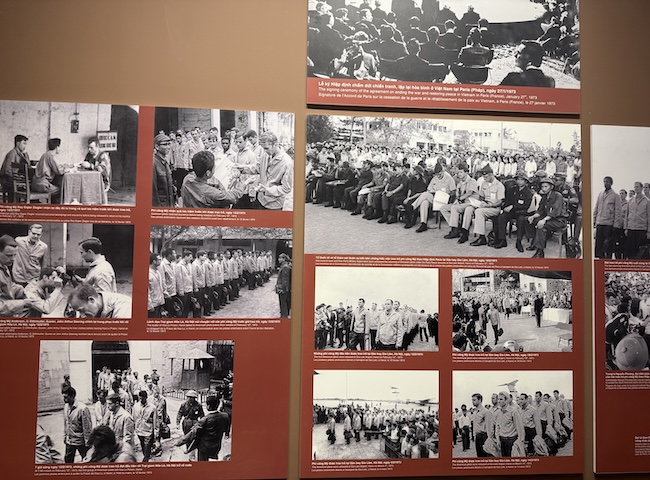
As a result, Nixon ordered an end to the bombings. The Agreement on Ending the War and Restoring Peace in Viet Nam, or the Paris Peace Accords, was later signed on our favor on January 27, 1973. Two weeks later, the US’s Operation Homecoming began to repatriate 591 POWs on what they called “the Hanoi Taxi”.
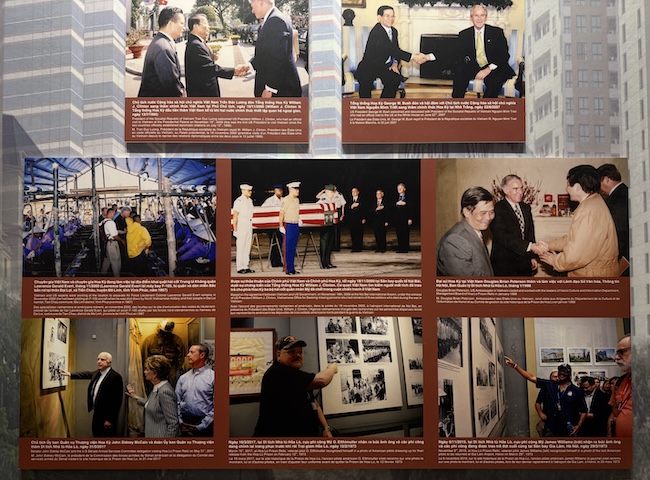
Vietnam and the United States normalized diplomatic relations in 1995, it marked the end of decades of hostility and began a new era of bilateral cooperation. The relationship between the two countries is currently at an all-time high, characterized by a Comprehensive Strategic Partnership—the highest level in Vietnam’s diplomatic hierarchy.