Vietnam’s biggest and most important holiday is the Lunar New Year, celebrating the arrival of spring based on lunar calendar. The holiday is known as Tết, the short form of Tết Nguyên Đán in Sino-Vietnamese vocabulary, which literally means festivals on the first days of the year.
It’s been the time for families to reunite to celebrate, honor ancestors, send well wishes to loved ones, and embrace the promise of a prosperous year ahead. Therefore, Tết holds profound cultural and familial significance for every Vietnamese.
Within this blog post, Flavors of Hanoi would like to share this beautiful tradition with the world.

Lunar New Year vs Solar New Year
Vietnam officially uses the solar calendar for daily life, business, and international holidays, while simultaneously employing a localized lunisolar calendar for determining auspicious dates, agriculture activities, spiritual rituals, traditional festivals such as Tết Nguyên Đán.
The Solar New Year is fixed on January 1, following the 365-day sun cycle. While the Lunar New Year shifts yearly, following a 354-day lunisolar cycle. The 11-day difference means the holiday moves backward on the solar calendar each year, falling between January 21 and February 20.
Need to keep in mind that lunar is not always just “lunar”, it’s usually lunisolar. Necessitating, every 2-3 years, it adds a 13th intercalary month to align with the solar seasons.

Vietnamese Zodiac
The Vietnamese zodiac is originated from the Chinese zodiac in its usage and arrangement of animals, but distinctly replaces the ox with the water buffalo and the rabbit with the cat.
Accordingly, it consists of 12 animal signs assigned to years in a 12-year lunar cycle, representing personality traits and fortune. The order is: Rat, Buffalo, Tiger, Cat, Dragon, Snake, Horse, Goat, Monkey, Rooster, Dog, and Pig. Following is the Gregorian dates, Vietnamese zodiac signs, and the according characteristic they represent.
Gregorian New Year’s Day – Zodiac signs – Characteristic
- 25 Jan 2020 – Rat – Frugal, ambitious, charming.
- 12 Feb 2021 – Buffalo – Perseverant, hardworking, stubborn.
- 01 Feb 2022 – Tiger – Courageous, candid, adventurous.
- 22 Jan 2023 – Cat – Gentle, intelligent, lucky.
- 10 Feb 2024 – Dragon – Independent, fortunate, temperamental
- 29 Jan 2025 – Snake – Ambitious, wise, determined.
- 17 Feb 2026 – Horse – Energetic, independent, positive.
- 06 Feb 2027 – Goat – Patient, persuasive, timid.
- 26 Jan 2028 – Monkey – Intelligent, curious, passionate.
- 13 Feb 2029 – Rooster – Hardworking, observant, honest.
- 02 Feb 2030 – Dog – Loyal, honest, likeable.
- 23 Jan 2031 – Pig – Generous, diligent, good-mannered.
When is Tết Holiday in 2026?
In 2026, Tết falls on February 17. It marks the start of the Year of the Horse, which is associated with themes of vitality and forward momentum. The official holiday period runs from February 14 to February 22.
How Do We Celebrate Tết?
Customs of Tết’s celebration are generally divided into three periods: including Preparation for Tết, New Year’s Eve, and the First 3 Days of the New Year.
1. Preparation for Tết
About two weeks before Tết, houses are meticulously cleaned to remove bad luck from the previous year, then decorated with red and yellow for luck. People who work far-away start returning home to be with their families.
On the 23rd day of the last lunar month, families hold a ceremony to send the Kitchen Gods to heaven to report on the household’s activities.

On the following days, we visit our ancestral homeland to give offerings at the family altar and pay respects at ancestors’ graves, where we spend time to clean gravesites and invite our ancestors to go home to enjoy Tết with us.
Markets and streets are crowded with people buying new clothes, gifts, food, and decorative items. Vibrant plants like kumquat trees and peach blossoms (in the North) and apricot blossoms (in the South) are bought and displayed in the living room.
Tết is signified with the making of bánh chưng (square sticky rice cake in the North), or bánh tét (cylindrical in the South). The traditional cake is made of glutinous rice, mung bean, and minced pork. It’s then boiled for about 10 hours, so it’s ussualy prepared together by family members a couple days before the New Year.
2. New Year’s Eve
New Year’s Eve is Giao Thừa in Vietnamese, which is a truly family-focused time for Tết. Families gather to worship ancestors, many visit pagodas to pray for luck and blessings for the coming year, eat traditional foods, and watch fireworks signaling the arrival of spring. It’s similar to a mix of Christmas and New Year plus the aroma of the burning incense.
3. First 3 Days of Tết
The first day of Tết is reserved for the immediate family. Traditionally, children wear their new clothes, and give their elders well wishes before receiving red envelopes containing money -symbolizing blessings from their elders. This tradition is called mừng tuổi (happy age) in the North, and lì xì in the South.
According to Vietnamese tradition, if good things come to a family on the first day of the lunar New Year, the entire following year will also be full of blessings. The first visitor to the family determines the family’s fortune for the whole year, the verb of being the first person to enter a house at Tết is xông đất or xông nhà.
People try not to visit someone’s home on the first day without being invited in advance. Usually, a person of good temper, morality, and success will be a lucky sign for the host family and be first invited.
However, just to be safe, the owner will leave home a few minutes before midnight and come back just as the clock strikes midnight to prevent anyone else from entering the house first who might potentially bring any unfortunate events in the new year to the household. This is a common practice done by many families.
Sweeping during Tết is a taboo, it symbolizes sweeping the luck away. It’s also a taboo for anyone who experienced a recent loss of a family member to visit anyone else during Tết.
It’s important to retain harmony within the famkly during the first three days of Tết. Engaging in conflict, arguments, or exhibiting any feelings of anger and hatred may bring upon bad luck for the upcoming year.
During subsequent days, people visit relatives, Buddhist pagodas, and friends. Traditionally but not strictly, the second day of Tết is usually reserved for friends, while the third day is for teachers, who command respect in Vietnam.

Common Wishes for Tết
There are numerous ways to express New Year wishes, which range from formal to personal or even humorous. Here are some of the most frequently used wishes, each starts with “I wish you” or “I hope you”:
- “Chúc mừng năm mới!” (Happy New Year!)
- “Dồi dào sức khỏe” (Plenty of health)
- “Tiền vô như nước” (Money flows in like water)
- “An khang thịnh vượng” (Security, good health, and prosperity)
- “Vạn sự như ý” (May all things go favorably)
- “Sống lâu trăm tuổi” (Live a long life of 100 years)
Food During Tết in Hanoi
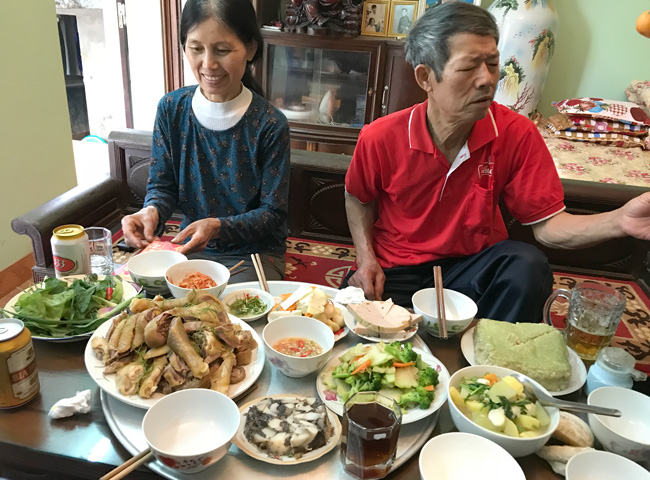
Food plays a central role in Hanoian culture, traditional dishes during Tết include the bánh chưng and five-fruit tray. Those symbolizes gratitude of ancestors, harmony, family unity, and the hope for a prosperous year ahead.
Other foods to flavor the steamed rice include boiled chicken (often a rooster to represent prosperity and success), pork sausages and pork ear roll eaten with pickled vegetables or pickled onions, jellied pork with wood ear mushrooms, and bamboo shoot soup, fried spring rolls, and red sticky rice symbolizing luck.
Snacks paring with tea and to invite guests as tokens of hospitality during Tết are candied fruits like coconut, sugared melon, ginger, and lotus seeds, red melon seeds, sunflower seeds, and watermelon seeds.
To Vietnamese, Tết is a break from the ordinary routine, which allows them to return home and pay tribute to those who have shaped them, and it’s reflecting the beautiful tradition of “uống nước nhớ nguồn (when drinking water, think of its source).